Tuesday, September 1, 2015

Media Literacy in a Media Driven World


I recently read a really good book called Master the Media by Julie Smith.  In her book she talks about all the different kinds of media from the basics of TV, radio and newspaper (that seem to be not nearly as popular) to social media and the internet.

I guess I am (along with probably a few others) one that remembers radio, TV and newspaper as being the only "trusted" source of news and information years ago.  The proliferation of all of the new sources of news available today sometimes seems to put me in overload.  One of the things I've noticed is news today is much more sound bite oriented than it used to be.  We have become a society and culture where that is all we seem to have time for.  Going wide and never digging deep doesn't give you the full story, nor do you often see the slant or bias the media source puts on the information and who the news source is serving.  The author does a nice job of dissecting each of the different media sources, both good and bad and helps the reader understand the implications and effects of them.

This is a great book for teachers to use in their classrooms as well as for parents at home.  I don't often recommend books to parents, however this one I did because I think it is important for kids today today to be "media smart" in a time where there is so much being put out there and the line between reality and fiction continues to blur.  It is our responsibility as educators and adults to make sure our kids understand and are able to "master the media".

For more information you can follow the author Julie Smith on Twitter at @julnilsmith or #medialiteracy

What are your thoughts?  Feel free to share.

Friday, July 3, 2015

You Can Lead a Horse to Water....

I've been thinking lately that as much as I have learned with my Twitter PLN, why I can't seem to get my teachers to get on board with trying it too!  Many have told me that they still see it in the old paradigm of 140 characters of communication done by kids and others, and not the powerful learning network that it is for all educators.

So, that's the struggle I have as I continue to lead my staff in the 21st century, leading the horse to water.  Alas I can't make them drink it though!  I hope through continued modeling and talking about all that I am learning via my Twitter PLN, that they come to at least try it.

There is a great book out written by Todd Whitaker, Jeff Zoul and Jimmy Casas called "What Connected Educators Do Differently" that does a phenomenal job of laying out getting connected via Twitter etc.  Therein, I think, lies my hope and answers for leading the horses to "water" AND make them drink it.

In His Service,

Axel Gruen

Wednesday, July 1, 2015

Technology Invades the Classroom

I know it's no surprise that technology has invaded our classrooms.  I chose that word very carefully and intentionally for the title of this blog post.  In many senses, in some of the classrooms of our schools, technology has invaded the classrooms!  We acquire technology for the classrooms, and suddenly the tech takes over and we lose focus on what the tech should be doing in the classroom.  Thus it has invaded/taken over what we do in the classroom, rather than keeping control ourselves.

In some of our smaller Lutheran schools, of which I am the principal of one, we get so focused on wanting/needing technology in our schools for various reasons.  We see it all around us, schools that have more tech tools, gadgets etc. and we become focused on the acquisition of tech for the sake of tech.  That's not what should happen.  We need to be good stewards of the money we are given and spend and use it wisely.

As leaders of our schools, we are responsible for setting the tone of the things that go on in our schools.  When we lose focus on the use of tech, where do you think our teachers get that from?  They end up doing the same thing in their classrooms.  They use the tech tools we give them with little thought to the pedagogy that needs to come first. 

In the wake of the ISTE conference that is ending today, I've tried to keep up with everything that is coming out of it. One of the things I read, and continue to read in other places is that, as educators, we need to make sure that the pedagogy of the lessons we teach come first and then figure out ways to infuse technology as it makes sense in the lesson, not the other way around!  I read a good blog post today by @mrkempnz entitled "The 4 Biggest Mistakes that Teachers Make When Integrating Technology".  He makes some great points worth taking to heart!Therein lies the challenge for some of us (including me sometimes) of making sure we are focused on the right things.  We need to help our teachers have that same focus as they plan what goes on in their classrooms.  There are so many things that can be done, but that doesn't mean they should all be done.

As we edge closer to the new school year, I am going to remain vigilant and aware of the invasion of technology in my school and help my teachers to understand its proper place in their classrooms(but strongly encourage them to use it)!  After all, they come first, not the tech!

There is a great quote I read somewhere on Twitter recently that I love that sticks with me that says "technology in the hands of great teachers is transformational".  That should be the goal for all of us as educators.  Teachers are the ones that make the difference, not technology!

In His Service!

Axel Gruen

Tuesday, June 30, 2015

My ISTE 2015 Experience

It has been interesting to follow the ISTE 2015 conference from afar these last couple of days.  I have never been to this conference but am now very intrigued by it.  There is so much to learn even from home, that I almost feel overwhelmed by the learning being posted on Twitter.

I am very thankful that in this day and age that technology exists that we can get and read information being presented at a conference, even if we can't attend.  That's not to say there is no value in attending, there is!  Sometimes schedules, finances or other don't allow us to do so.

I am also thankful for all the connected educators that I follow on Twitter that allow me to be able to still get vital, cutting edge education information.

At some point I hope to attend an ISTE conference so I can truly get the full experience, but until then, thank you to my Twitter PLN for keeping me in the loop!

In His Service!

Axel Gruen

Monday, May 25, 2015

DITCH That Textbook


I just finished this amazing book by Matt Miller. Initially I was apprehensive about the title of the book and whether there would be application in an elementary/middle school setting.  Happily I was proven wrong.  There are a ton of great concepts that can apply at any level.

If you look, DITCH is an acronym which stands for Different, Innovative, Tech-laden, Creative and Hands-on. Any or all of these can apply in any classroom at any grade level.

He lays out the book in four sections.  In the first section he answers the question why go digital? The last three chapters of this section hit me the most.  Chapter 6 deals with reinventing education.  There is no doubt in my mind that education needs a makeover, probably even a total redo.  The crux of the discussion here is the move from the 19th century factory model of education to the 21st century model where we educate the students for jobs that haven't yet been created.  We need to prepare them for the world they will be living in, not the world we know now.  Chapter 7 talks about the fact that educators today are no longer the gatekeepers of the knowledge, the sage on the stage, rather the guide on the side.  That's a real mind shift for many teachers (and parents alike). The last chapter is all about giving the kids real world skills, again not the ones of our world but the ones they will need at some point.

The next section had a ton of stuff in it and I walked away with some of the following.  He references from Dave Burgess's book Teach Like a Pirate that I think is awesome and that is "Don't just teach a lesson, create an experience."  That's what students want and we want, engagement!  While students don't have much of a choice of whether to come to school or not, as educators we can certainly make it more engaging and tap into their passion by connecting what we teach to what they know from their world.

For so long we talked about tech being the thing that everyone had to have in the classroom for the sake of having but he makes great points by saying that "pedagogy must drive technology" and "if I'm going to use any form of technology, it must improve my students' learning experience." That makes so much more sense now, especially in light of the fact that tech is constantly changing and that there are multiple uses for much of the tech out there now.  We (educators) need to be more discerning than we have been in the past.  I know that it has driven my tech choices in the schools that I have served in recent years, a change from we have to buy whatever is out there and new regardless of what it is or if we know how to use it.  We need to be good stewards of the money we use for technology in our schools.

In the third section, he gets into the meat of ditching your textbooks.  He gives lots of great advice and examples of how it should and should not be done.  Examples from his classroom bring the points home. 

Finally, in the last section he spends a little time about ditching your curriculum.  He acknowledges that it may not work for everyone, especially if what you teach is tied to what others teach and needs to connect in some way.  He also acknowledges that district mandates may not make that possible in all areas due to what must be taught in classrooms.  He does emphasize taking your time and not doing everything all at once (a theme throughout the entire book). Many times we find ourselves so excited about all the new things we read about or see at a conference or workshop, we want to do it all.  He cautions against doing too much to soon.  Have patience and give your students time to digest the new stuff.

This book is what I consider part of a trifecta of books that I think all need to be read together.  They all complement one another very well and embody similar overlapping ideas and concepts.  The other two books are Teach Like a Pirate by Dave Burgess and Learn Like a Pirate by Paul Solarz. 

There is another book that I think complements it as well, one I have not read yet, called Pure Genius by Don Wettrick.  It talks about a concept that Paul Solarz calls "Passion Time" and Don Wettrick and Matt Miller call "Genius Hour". I look forward to reading Don Wettrick's book and finding ways to apply the concepts in all four books in the school I serve.  My challenge will be to take it slow and just a piece or two at a time like Matt Miller recommends.

Serving Him!

Thursday, May 21, 2015

Learn Like a Pirate-Peer Collaboration


So the adventure continues as I sail through this awesome book.  Section two focuses on the traits of "Learn like a Pirate" below:
Peer Collaboration
Improvement Focus vs Grade Focus
Responsibility
Active Learning
Twenty-First Century Skills Focus
Empowerment

Peer Collaboration

"People who work together will win, whether it be against complex football defenses or the problems of modern society" Vince Lombardi

I loved this section of the book.  The thought of students working together and collaborating toward a common goal is an awesome thing.  Paul Solarz does such a great job of conveying it in his book.  This and the upcoming blogs will focus on a section of the book in a sort of book review style.  I'll highlight some things that stood out for me as well as share a few of my own thoughts on those ideas.  Below are four things I pulled out of this section as I was reading it:

  • This section is about collaboration in the student-led classroom.  If you're at all like me, you cringe at giving your students "control" in your classroom.  You have your way of doing things, that, in your mind, works. Giving that up to the students just goes against your better judgement.  Yet, this is one of the very things that makes students successful in school and brings enjoyment and passion for learning.  In the book, Paul says that "peer-collaboration is one way to make a student-led classroom work." You have to give up control for collaboration to work.
  • One of the benefits Paul shares in the book about a student-led collaborative classroom is that it allows students to think about other people's ideas and then synthesizing them with theirs.  He tells his students that "two brains are better than one!" What a great thing to say! Love that idea. Think about how much more the students learn when they share what they're thinking with someone else!  Many times new ideas are born or even a totally different perspective.  No two people always see the same idea the same way.  The real world the kids will one day enter, is asking for these kinds of skills from our students.  In fact, collaboration is one of the skills today's employers want now.  Tons of examples in this section of the book.
  • One of the great takeaways from this section, in my opinion, is the idea of students being able to call "Give Me Five" and allow the class to stop what it is doing and have that student share an important piece of information, answer or something he/she discovered.  It empowers the students to lead!  He says for that to work you need to give students the opportunity for active and passive leadership in your classroom. There are all kinds of ways to do that and he gives examples.  The students want that kind of responsibility so let them have it!  When you empower your students to do that, the Give Me Five becomes a natural part of it.
  • The last thought is from his section on promoting the right kind of competition.  The only thing I'll share is this quote: "I want a room full of learners, not perfectionists.  I want my students to work hard because they choose to, not because they fear negative consequences.
Because "two brains are better than one", feel free to share your thoughts so that we can all collaborate and learn together!

Until my next port of call, Improvement Focus vs. Grade Focus, keep on sailing the PIRATE seas.

Serving Him,

Saturday, May 9, 2015

Learn Like a Pirate-Part 1

After much anticipation on my part I am finally sailing on my pirate adventure with the book written by Paul Solarz called Learn Like a Pirate!  I got through section one of the book which talked about the student-led classroom and what it is and isn't.  Paul does a great job of setting up the rest of the book.  I'm really looking forward to reading more.

For those teachers who like "control" in the classroom, this will certainly challenge your thinking.  He writes in there that "a student-led classroom is one in which students make decisions and choices throughout the day without consulting the teacher."  He does caution though that while in a student-led classroom that does take place, there is still guidance and oversight by the teacher.  Phew!  That made me feel better!

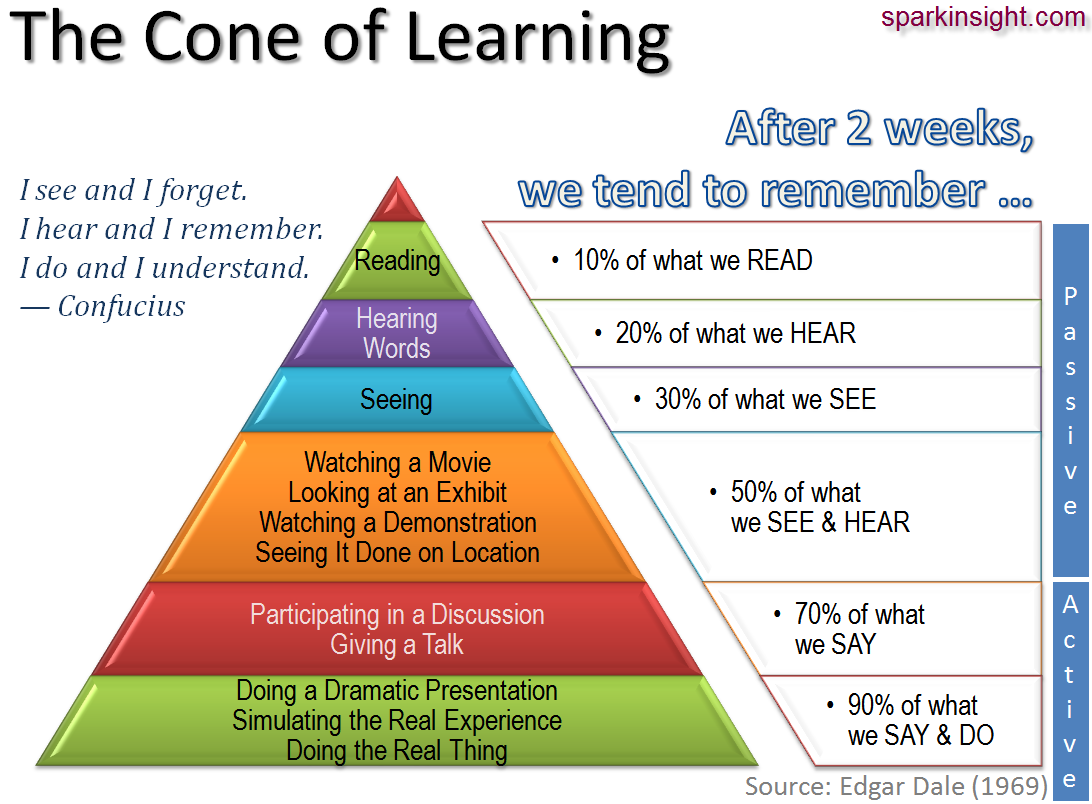
As he writes about experiencing the benefits of a student-led classroom, he mentions a lot about knowledge retention.  He says that "children learn best by doing, by questioning, and by figuring out solutions on their own."  He references the graphic on the right in his book, called The Cone of Learning.  This was one of my biggest takeaways in this section of the book for me.  It just makes sense that if this is the way students learn best, why not do it.

Anyway, I can't wait to read more from his book. As I continue sailing on my pirate adventure in the book, I'll share more insights.

By the way, I would also highly recommend the book Teach Like a Pirate by Dave Burgess.  I read that book last summer and found it very inspiring.

Until my  next port of call, mates!

Serving Him!